Why Your Dream Business Is a Bad First Business
Restaurants, gas stations, and laundromats cost hundreds of thousands before the first sale. Here is why a low overhead business is the smarter place to start.
September 20, 2026
A 20 year old with good credit and no savings recently asked an online forum how to start a business with no money. The businesses he named were a mini market, a gas station, and a laundromat.
We love that question, and we mean that. Those are real businesses that real people own and run profitably. The instinct to build something with a roof and a sign over the door is a good instinct. Dream big. Keep the dream.
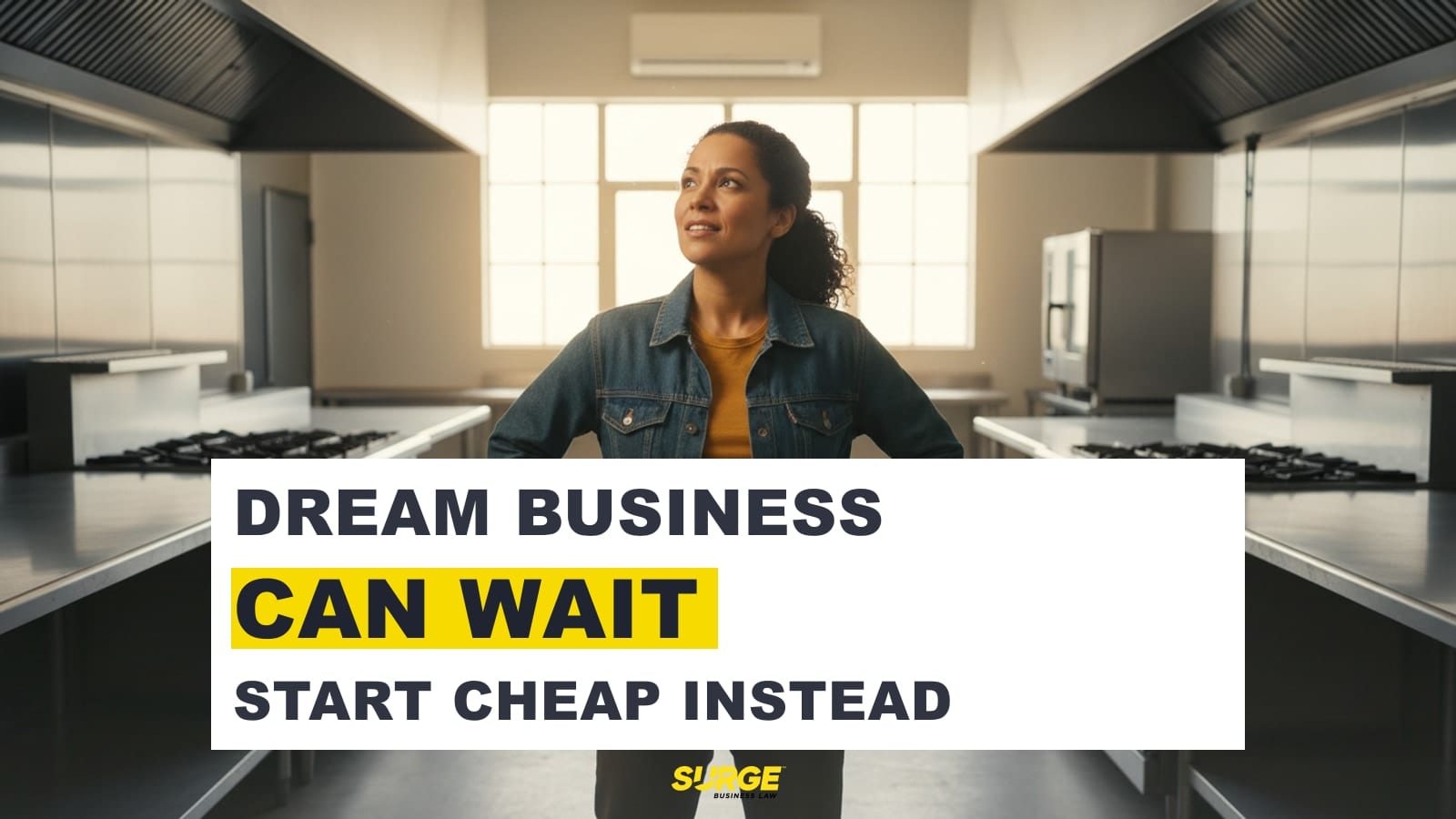
The more money a business needs before it earns its first dollar, the riskier it is. Your first business is the worst place to carry that risk. Start something cheap instead. Learn to sell, learn to price, learn to get paid. Then go after the expensive business, with money coming in, real experience, and a lender who takes your call.
The Problem Is Not the Dream, It Is the Order
Every business carries risk. What varies is when you find out you were wrong.
In a service business, you find out in week two, for the price of two weeks. In a business that costs a lot to open, you find out in month fourteen. That is after the buildout, the equipment, the permits, and three months of payroll. By then the tuition has been paid, and it was paid with borrowed money that has your personal guarantee on it.
That timing difference is the whole argument. It is not about ambition. It is about how expensive your first mistake is allowed to be.
What These Businesses Actually Cost
Numbers make this concrete. These are broad national ranges. They move a lot with market, condition, and whether you lease or buy the real estate. Treat them as the order of magnitude, not a quote.
A restaurant rarely opens for less than a quarter of a million dollars. Half a million is more realistic. Count the buildout, the hoods and grease interception, and the kitchen equipment. Then furniture, point of sale, liquor licensing where it applies, opening inventory, and deposits. Then you still need enough cash to survive the slow months while you find your customers.
A gas station adds layers most first time buyers never price. Underground storage tanks come with environmental rules and a long tail of possible liability. Fuel supply agreements and branding contracts come with volume commitments. The convenience store inside is its own inventory business, with its own theft problem and its own licensing.
A laundromat looks passive from the sidewalk and is not. Commercial washers and dryers are expensive. Running them usually takes plumbing and electrical work the landlord will not pay for. The machines also wear out on a schedule, so you need a reserve set aside to replace them.
The Real Problem: You Start From a Deficit
Here is the structural issue those numbers point to. In each of these businesses, you spend nearly all of the money before you earn any of it.
Day one of a consulting practice, you are at zero and the next phone call moves you up. Day one of a restaurant, you are several hundred thousand dollars down. You signed a personal guarantee on the lease. The next customer moves you up by about forty dollars. You are not trying to build a profit yet. You are trying to climb out of a hole you dug on purpose.
A service business asks you to be good at the work. A business that costs a lot to open asks for more. You have to be right about the market before you have met a single customer.
This is a large part of why restaurants have such a difficult reputation. It is not that restaurant owners are careless. It is that the model stacks heavy upfront cost, high labor costs, perishable inventory, and thin margins on top of each other. Every one of those is survivable alone. Together, they leave almost no room for the ordinary mistakes a first time owner is guaranteed to make.
Expensive First Business
- Hundreds of thousands spent before the first sale
- Lease and loan personally guaranteed
- Fixed costs run whether customers show up or not
- Mistakes are discovered late and cost real money
- Exit usually means selling assets at a loss
Low Overhead First Business
- Revenue starts in the first weeks
- Little or no debt and no long lease
- Costs scale down when demand does
- Mistakes are discovered early and cost time
- Exit means simply stopping
The Low Overhead Path, and Why It Is Not a Downgrade
Starting small is not settling. It is buying information cheaply.
A service business teaches you the skills that decide whether the big business survives later. How to price so you make money. How to sell without discounting. How to collect from a customer who is slow to pay. How to hire, and how to fire. How to read your own numbers. Those skills carry over. The money does not help you if you never learned them.
It also produces the two things a lender wants to see when you go after the bigger deal. A track record, and a down payment. Want the mechanics of a start with no money? Read Can You Start a Business With No Money? It covers why insurance comes before an entity. To see how funding actually moves up from there, The Capital Ladder lays out the rungs in order.
Ready to set up a low overhead business properly? Our Launch 360 package covers formation plus the guidance that usually matters more than the filing itself.
There Is a Third Option: Buy It Instead of Build It
Most people see two choices. The small business they can afford, or the big business they want. There is a third path, and for businesses like these it is often the better one.
Buying an existing gas station, laundromat, or restaurant is a different transaction from building one. You are not spending money ahead of revenue. You are buying revenue that already exists. It comes with a customer base, a permit history, equipment already installed, and financial statements a lender can read. That is also why financing to buy is generally easier to get than financing to start, in the same category.
If that path interests you, our guide to buying a business walks through valuation, diligence, and deal structure.
Dream Big, Start Smart
None of this is an argument against opening a restaurant. It is an argument against opening one first, with no money, no operating history, and no experience managing labor and inventory.
Plenty of people get there. They usually get there second. They run something smaller first, build a financial history, and learn the unglamorous parts. Then they buy or build the thing they wanted, with enough behind them to survive a bad quarter.
We have a case study coming soon with Alex, a restaurant owner who used some creative financing to make his launch work. Watch for that one. It shows what this looks like when somebody does it with their eyes open.
The question in front of you is about order, not about whether. If you want help deciding whether to start small, start now, or buy something that already runs, book a free consultation. We would rather talk you through the order of operations than read the lease after you have signed it.